
American Mythos
Venezuela, Minnesota, and the Competing Foundational Myths of the American Empire

“The images of myth must be the daemonic guardians, ubiquitous but unnoticed, presiding over the growth of the child’s mind and interpreting to the mature man his life and struggles. Nor does the commonwealth know any more potent unwritten law than that mythic foundation which guarantees its union with religion and its basis in mythic conceptions.” - Friedrich Nietzsche, The Birth of Tragedy, Section 23 (136-137)
You might have heard about the ‘civil war’ occurring on the American Right. At first glance, what may appear to be merely a war for political power in President Trump’s administration has proven to be a fight not only for the culture but, more importantly, for the nation’s soul. Although the fractures have existed for decades, 2025’s horrifying assassination of Charlie Kirk brought those fissures to the forefront.
Nowhere was this clearer than at this past month’s AmericaFest 2025 (AmFest), an annual political conference started by the late Kirk and his organization, Turning Point USA. Stakes were already high for the conservative juggernaut, considering Kirk was murdered only three months ago, and the ensuing investigation has ignited a firestorm of controversy, much of which has centered around Kirk’s widow, Erika. But even before Kirk’s untimely death, the question of who would speak at AmFest had invited conflict for the Millennial influencer and the American Right, more broadly. Would Kirk satisfy his donors by featuring only pro-Zionist pundits like Shapiro, or would he defy them and invite the increasingly contentious (and anti-Zionist) Carlson to speak publicly as well?

(*Pictured above: leaked WhatsApp messages between Kirk and Turning Point staff members regarding not only the subject of Carlson, but also Kirk’s evolving opinions on Israel.)
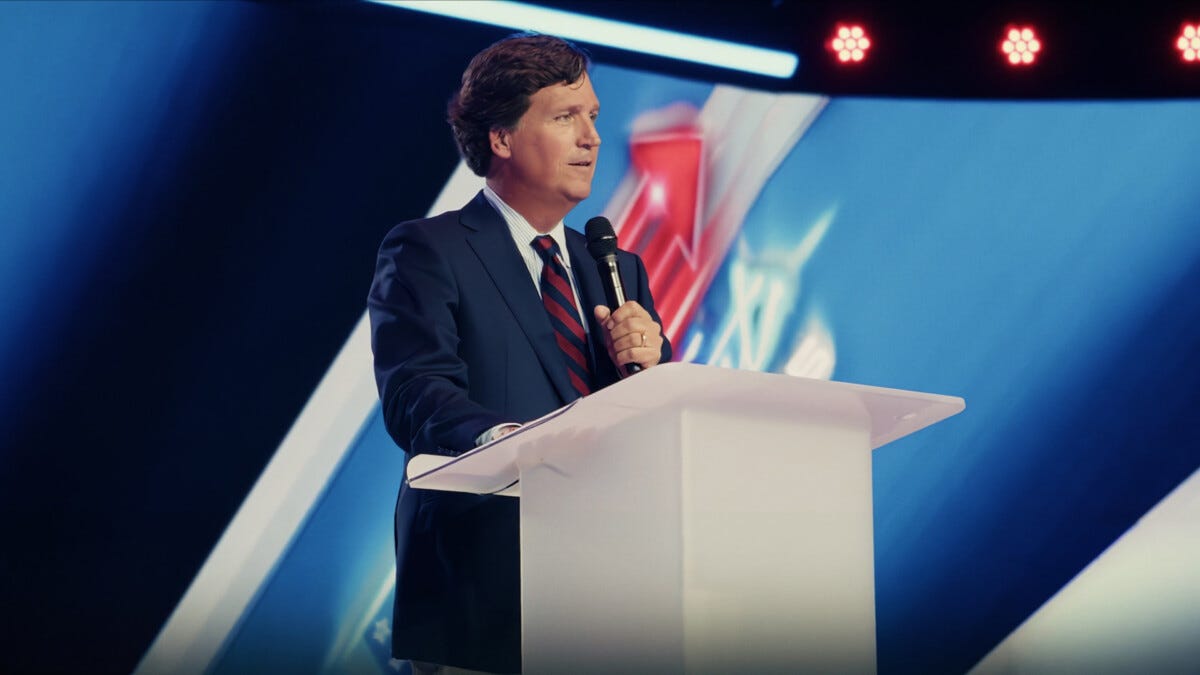
As it turned out, Kirk got what he wished, and Carlson won this round. Both Shapiro and Carlson spoke at the event and referenced each other, not even bothering to deny the existential rift that has ruptured America’s political right wing. It was a case of feuding prophets competing in their bid to diagnose the nation’s rot and prescribe its antidote. I argue that these two factions are best characterized as “classical liberalism” versus “national populism,” the former represented by figures such as Ben Shapiro and the latter by Tucker Carlson.
Shapiro espoused the explicit values of TPUSA, including “freedom, free markets, and limited government,” but focused philosophically on the importance of “truth.” Or, “how to discern those attempting to speak truth from frauds and grifters.” From Shapiro’s perspective, these “frauds and grifters” like Carlson have emerged from the collapse of corporate media and pose a threat not just to ‘truth’ but also the conservative movement writ large. Parroting the familiar cultural trope of ‘left vs. right,’ Shapiro argued that Carlson and his allies present “a danger to the only movement capable of stopping the Left from wrecking the country wholesale.”
It’s the customary and proverbial narrative of postwar America: secular, liberal democracy is best. But of course, one’s cultural and political preference for that type of society is limited to one of two versions of it. Blue vs. red. Democrats vs. Republicans. Liberals vs. conservatives. Left vs. right. Us vs. them. This ‘culture war’ has animated political theater for as long as most American generations have lived, and usually provided the moral framework for every internal battle from foreign policy and taxes to abortion and gay marriage. Even with gradations, the American political system offers only these options through its two-party system. You can have Obama or Romney, Bush or Gore, Trump or Clinton. There is no other viable choice.
But the 2020s introduced a sledgehammer to this classic narrative after the disruption of COVID-19. Suddenly, ‘right vs. left’ started to shift towards ‘compliant vs. dissident.’ Although some of the old tropes spilled over into the new paradigm, many figures began to abandon this culture war in an effort to combat the tyranny of COVID protocols and vaccine mandates. New coalitions, such as MAHA (Make America Healthy Again), gained momentum across the political divide, directly leading to the nomination and confirmation of Robert F. Kennedy Jr. as Secretary of the Department of Health and Human Services. Suddenly, liberals and conservatives alike could unite in concern about bureaucratic mismanagement of public health and corporate control over medicine and food. The political divide seemed less dangerous than the political and corporate institutions that upheld it.
In the wake of this seismic shift, another coalition emerged after the October 7th attacks in 2023. Until this moment, public opinion towards Israel was largely exempt from the culture war. Although some younger and more “radical” factions of the American Left openly criticized Israel for its treatment of Palestinians for years, the American political establishment was solidly behind its “greatest ally.” So much so that questioning this ally was not allowed in the corporate agora of legacy media. To even hint at such criticism invited nothing but strident accusations of anti-Semitism, one of the original sins of postwar America. On the political right, this was buttressed by American Christianity’s century-long embrace of Zionism. The state of Israel could always count on conservatives’ support until October 7th.
While social media enabled the exposure of political and corporate malfeasance behind the COVID-19 crisis, it also uncovered Israel’s savage and unjust response to Hamas’ attacks on October 7th. As videos and images of mutilated and starving children, bombed churches, and demolished homes swarmed the public’s phones, Israel’s claim to moral authority increasingly came under harsh scrutiny. Two years later, that scrutiny has led to a growing bloc of vociferous and passionate (not to mention demographically younger) anti-Zionists on the political right wing, the leader of which is undoubtedly Carlson himself. Now, across the spectrum, Millennials and Gen Z’ers are becoming united against Israel.1
Once a corporate stooge of legacy media, the Gen X journalist emerged from the chaos of Covid as a fervently independent and dissident reporter. After Fox News fired Carlson, who hosted the highest-rated program on cable news at the time in 2023, he accused the ‘conservative’ news network of caving to ‘Big Pharma.’ Indeed, Carlson’s firing came only days after he accused the network of peddling the COVID-19 vaccines on behalf of their pharmaceutical advertisers. In retaliation, Carlson launched his own venture, the Tucker Carlson Network, which has since become one of the country's top news podcasts. In addition to interviewing “conspiracy theorists” on topics ranging from geoengineering to Kabbalah, Carlson has also interviewed Nick Fuentes, Candace Owens, Vladimir Putin, Ted Cruz, and an array of public figures. Carlson has also consistently spoken with whistleblowers, academics, and activists who are highly critical of the Israeli government. Naturally, this has made him one of the primary targets of the pro-Zionist and pro-Israeli political right, who claim that Tucker Carlson is now one of the worst anti-Semites in the country.2
This has become the battle line for the ‘civil war’ on the American right: the United States’ relationship with the state of Israel. For classical liberals such as Orthodox Jewish-American Shapiro, the answer is unequivocally clear. Not only should the United States continue to financially and militarily support the foreign nation for ‘strategic’ reasons in the Middle East. It should also do so out of moral obligation, in efforts to protect Jews and the Jewish ethno-state, as well as protect the values of liberal democracy, which Israel claims to be. This is because the state of Israel - and the United States’ moral obligation to protect it - are predicated on the victory of World War II, a moment in history in which the United States attained military, cultural, and political hegemony.
It is the great American mythos, the origin story of the American Empire. Because of Americans’ sacrifices, after the trials of the Great Depression, the morally righteous, “Judeo-Christian” nation was able to defeat the evil Axis Powers, including the racist, far-right Nazi regime and its chief arch-villain, Adolf Hitler. As a result of her heroic victory, America (justifiably, according to the mythos) became a world power and was able to spread the gospel of capitalism, democracy, and freedom. Thus, Lady Liberty would be the protectoress of this new global order, ensuring, occasionally through military intervention or economic sanctions, a status quo in which all nations could pursue self-determination, especially Israel, which was established in 1948, three years after the end of the war.
Like The Aeneid, this is the great founding myth of an empire. A story that provides explanation and meaning, particularly for the existence of a god-like entity. Just as the lost Trojan prince, Aeneas, bravely escaped the catastrophic destruction of his home, Troy, and followed the gods, rather than his heart, the American G.I. bravely left his homeland to free the world from tyranny. For her part, the dutiful American wife patiently waited for her husband and proved herself as a capable (and profitable) worker, as noble as Odysseus’s Penelope. For these sacrifices, the almighty Jupiter promised Aeneas “an empire without limit,” and by the second century AD, Rome had indeed conquered the known world. Abandoning his great love, Queen Dido, in North Africa, enabled Aeneas to eventually discover what would become (at the time) the world’s greatest empire.
Of course, this is imperial propaganda. Virgil wrote The Aeneid while in the employment of Caesar Augustus (formerly Octavian), and the epic “offers a memorable and eloquent image of a new golden age for Rome and its empire, with Augustus centre stage.”3 After following in his adoptive father’s footsteps (Julius Caesar) and defeating rival Mark Antony and his lover Cleopatra at the Battle of Actium, Augustus manifested what had already started in prior centuries: the transition of Rome from republic to empire. But in Augustus’s eyes, this was no tragedy. An empire without limit would pave the way for Pax Romana (“Roman Peace”), an era of stability, prosperity, and virtue after decades of civil war and chaos. Nor would Augustus be a cruel dictator. Rather, he would be known as princeps (“first citizen”), the first among many. The empire, led by its ‘first citizen,’ would usher in peace in a world torn apart by war.
Unsurprisingly, American propaganda has also painted the country in a similar light. After the horrors of two world wars, the Great Depression, and the Bolshevik Revolution, America would lead the way in establishing global peace and order. Though still under the official guise of a ‘republic,’ America would seize global hegemony by controlling not only land and peoples but also resources and currency; a reality actualized barely two decades after the Allied Victory, when President Nixon took the U.S. off the international gold standard. The empire had already been set in motion, well before World War II, but the country’s increasing wealth and power (on the back of artificial centralized banking and military occupation) would help mask the transition. As long as Americans continued to earn more money and consume more goods, the mythology sufficed.
Now, twenty-six years into the 21st century, the mythos is crumbling. As 9/11 so painfully illustrated, the price of empire is indeed terrorism.4 America’s foray into the new millennium baptized the era of the Global War on Terror, an endless campaign not merely on “Islamic terrorism” in the Middle East, but now also “narcoterrorism” in South America, as evidenced by President Trump’s recent decision to force regime change in Venezuela. The cost? Trillions of dollars in debt5, millions of lives lost (American and elsewhere), an increasingly tarnished global reputation, and the blindingly fast diminishing value of the all-powerful American dollar. As it turns out, terrorism is not the only price associated with empire.
To his credit, Carlson himself recently acknowledged this reality on his show. During last week’s interview with Megyn Kelly, Carlson discussed the Trump administration’s decision to blatantly (rather than covertly) overthrow Maduro and seize control of Venezuela’s oil reserves:
What happened a few days ago in Venezuela is not just a big surprise to people who were watching it… it is the, effectively, the announcement by the U.S. government that our system is changing, that we are now explicitly an empire. We’re an empire… Of course, the argument has been made, and probabaly there’s some truth to it, that the United States has been an empire for a long time, at least the last 80 years, since 1945 when we emerged victorious from World War II, even 1918 when the British Empire, effectively, ended. Maybe even 1898 when we get Puerto Rico and a few years later, Cuba, from the Spanish Empire… But the difference between the last 120 years and earlier this week is that we never before aadmitted it, and now we are.6
Yes, as many historians, pundits, writers, and philosophers have long suspected, the U.S. Republic is really a global empire. Yet unlike his predecessors, President Trump is not trying to conceal this fact. Instead, he is embracing it, as evidenced by his cascade of autocratic executive orders. Even the recent killing in Minnesota last week speaks to this. In an effort to establish ‘order,’ the Trump administration’s deployment of I.C.E. agents in the midwestern state further signals the values of the American Empire. This emperor will restore ‘order and justice,’ even if it comes at the cost of American citizens. After all, the empire comes first.
Much to the delight of classical liberals such as Shapiro, this recent strife in Minnesota supports the imperial mythos many on the Right continue to peddle. Renee Nicole Good’s death represents, once again, the choice at hand: the radical Left or the conservative Right. Whereas ‘the Left’ offers chaos and disorder under the rule of a feminized and hyperemotional coalition of minority identity groups, the ‘Right’ offers the possibility of an orderly society committed to rooting out crime and fraud. Even if the United States is technically an empire, does that matter as long as it continues to parrot the values of “freedom, free markets, and limited government”?
Perhaps it does. While a segment of the American Right (and the American population in general) still embraces the imperial mythos of postwar America, an emerging division questions this myth. What if the story of the American Empire is different from what we were previously told? Carlson and the looming national-populist wing of the Right seemed to have awakened to another mythos, an equally ancient, albeit older and more disconcerting, story.
What if the mythos of America is more like that of Odysseus rather than Aeneas? Just as King Odysseus realized to his horror that he had wasted seven years on the island of Ogygia under the spell of Calypso, perhaps the American explorer has also discovered an awful truth. While our Anglo-European hero may have believed that he crossed the ocean to find an Edenic paradise ruled by a divine (and pure) earth goddess, he is now realizing that he was indeed in the midst of a dream. One could call it the ‘American Dream.’ He did not conquer the earth goddess and her virgin land. Rather, he has found himself unwittingly yoked to a temple prostitute; at best, a powerful enchantress in her own right, and at worst, a slave to the kinds of powers which animate empires (and demand worship). Now our hero also finds himself a slave, drunk off the excess of greed and passion.
If the American Right wishes to “save” this now-acknowledged empire, it will have to agree on a mythos. The same applies to the Left and, frankly, to the country at large. If America is to survive at all, it must decide which mythos undergirds its existence. As Nietzsche so aptly remarked, “man… stripped of myth, stands famished among all his pasts and must dig frantically for roots.”7 Is the American hero more like Aeneas, the son of Troy and father of empires without limit? Or is he more like Odysseus, the king of Ithaca, desperate to return to his rugged, modest, but beloved island home? A man who aided his peers in empire building, only to realize he belongs back in his kingdom.
History will determine the outcome, but the heroes will decide.
For reference, see the following: https://www.pewresearch.org/politics/2025/10/03/americans-views-of-israelis-palestinians-and-their-political-leadership/
https://www.imeupolicyproject.org/polls/gop-israel-2025
https://www.brookings.edu/articles/the-generation-gap-in-opinions-toward-israel/
“Tucker Carlson Named ‘Antisemite of the Year’ by Prominent Jewish Organization after Alarming Interviews.” StopAntisemitism, 21 Dec. 2025, stopantisemitism.org/12/21/tucker-carlson-named-antisemite-of-the-year-by-prominent-jewish-organization-after-alarming-interviews/.
Mary Beard. SPQR. Liveright Publishing Corporation, 2015.
As quoted by Pat Buchanan on page 239 in his book Where the Right Went Wrong. Thomas Dunne Books, 2005. The quote continues: “If we do not wish to pay it, we must give up the empire.”
$38.59T as of writing this essay: https://www.usdebtclock.org/.
“Megyn Kelly on Venezuela, Ben Shapiro’s Treachery, and Mark Levin’s Mental Illness.” YouTube, uploaded by Tucker Carlson, 8 Jan. 2026, www.youtube.com/watch?v=7HgM0aI3IK8.
Friedrich Nietzsche. The Birth of Tragedy & The Genealogy of Morals. Trans. Francis Golffing. Anchor Books, 1956. 137.
Good summary of where we are right now. What I suspect will happen is that as the Empire fractures into various geographic factions pursuing their own interests, the mythology will fracture in much the same way. The Deep South and Appalachia have their own respective mythic self-conceptions, for instance, which have been stewing ever since the Civil War and Reconstruction. New England and California are driven by Neo-Puritan Yankeeism, and will probably continue to do so, while the Rust Belt and upper Midwest are rooted in Germanic and Scandinavian industriousness and practicality (though I tend to think that more vigorous Irish and Italian Catholic culture might take the driver's seat?) And who can forget Texas, with its potent blend of Scots-Irish proud independence with Midwestern pragmatism?
I think people will be shocked by how quickly these localized myths roar back to the forefront as the Empire teeters. Appalachia, in particular, would likely relish a poorer but more autonomous existence than the current dichotomy of rich carpetbaggers occupying cultural centers like Asheville and Nashville and surrounding suburbs, and destitute rural areas beneath the Empire's concerns. Meanwhile Dixie, with their militaristic impulses barely restrained by college football, will be itching for a fight, and Texas is clearly quite capable of standing on their own.
Interesting times ahead, I'm sure.
Excellent essay. Thank you.